Summer Schools

SEP 15
Summer school

EUDAT Summer School 2023

Kajaani, Finland

EUDAT Conferences

NOV 25
Conferences

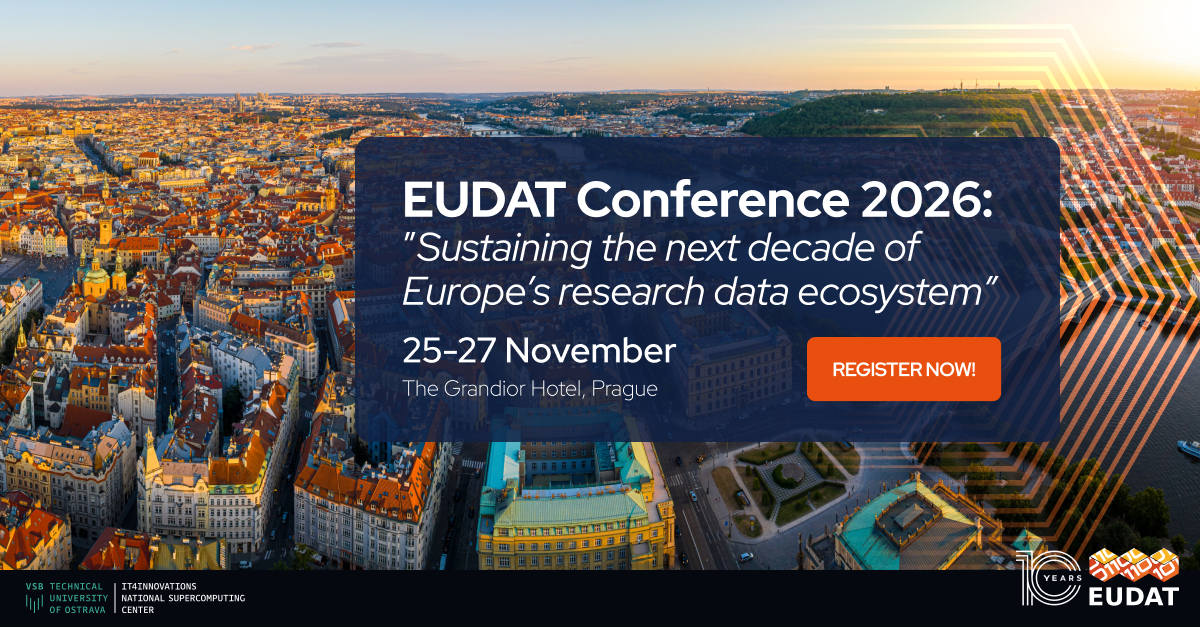
EUDAT Conference 2026

Prague, Czech Republic

EUDAT summer reading: in the spotlight the EOSC report, the new eInfraEU publication and the upcoming webinar on DMP

Summer has finally arrived: sit back, relax and catch up all the EUDAT latest updates! The first report of the High Level Expert Group on the European Open Science Cloud has just been released and we describe how EUDAT can contribute to the EOSC framework. The work done by EUDAT is also covered by the recently launched publication entitled “E-INFRASTRUCTURES: Making Europe the best place for Research and Innovation”... Curious how? Download the booklet! For those still at work, please mark the 7th of July in your calendar. At 11:00 CEST, EUDAT, jointly with OpenAIRE, has organised the webinar: "How to write a Data Management Plan". Last but not least this issue highlights how you can best benefit from the EUDAT services with the article: Are you a User or a Joiner? and helps you discover how EUDAT is contributing to Digital Infrastructures for Research 2016.

Communities old

One of EUDAT’s main ambitions is to bridge the gap between research infrastructures and e-Infrastructures through an active engagement strategy. EUDAT is privileged to have close and collaborative relations with its long-standing partner communities.

EUDAT Conference 2018: insights on the programme and new deadlines for contributions and early-bird registration

On 22-25 January 2018, data managers, scientists & research communities, policy-makers, e-Infrastructure initiatives, research infrastructures and ESFRI projects from all over Europe will gather in Porto (Portugal) to attend the next EUDAT Conference entitled "Putting the EOSC vision into practice".

iRODS, Data Staging and Persistent Identifiers

Collocated with IUPS2013 in Birmingham, but open to all, this free course will run from 10:30 until 16:30 on Sunday, 21st July, 2013.
We will cover iRODS, Data Staging and Persistent Identifiers. We'll introduce these technologies and concepts and then demonstrate how they can be used in the context of EUDAT's common data infrastructure.
Regsiter now at: http://eudat.eventbrite.co.uk.

D2.2.1 Services Rolling Plan

This report summarises, in context, the goals of the EUDAT project and analyses the service usage patterns distilled from the (ongoing) user requirements capture process. It uses these patterns to motivate and prioritise the choice of core services essential to the successful rollout of the EUDAT collaborative data infrastructure; a high-level plan for the delivery of these services is presented in the final chapter.